A Solo Urban Designer Used an AI Agent to Build a $2M Grants Pipeline, a 158-City Database, and Get $40K in Funding. Here's the Full Use Case.
Sam Altman has a bet going with his tech CEO friends about when the first one-person, billion-dollar company will arrive.
Sam Altman has a bet going with his tech CEO friends about when the first one-person, billion-dollar company will arrive. Dario Amodei, who runs Anthropic, was asked the same question at a keynote. His answer: “2026.”
That makes for great conference content. But while everyone debates whether some Stanford dropout will build a unicorn from a laptop, something less cinematic and more useful is already happening. Solo operators, small business owners, the kind of people who don’t get profiled in The Information, are using AI agents to do the operational work they could never afford to hire for.
This post is about one of those people.
What this use case actually is
Sarah Mitchell (name changed) runs a one-woman urban placemaking consultancy in the Mountain West. She designs and fabricates temporary public installations, modular kiosks, pop-up stages, street furniture, deploys them into underperforming public spaces using CNC fabrication, and measures what happens. Foot traffic. Dwell time. Social interaction patterns. Before a city commits millions to a permanent plaza, Sarah builds a proof-of-concept version in weeks and shows them the data.
Strong credentials. Master’s from a top design school in New York. A fellowship in inclusive design. A national design competition win. Work with state DOTs, downtown business alliances, and redevelopment agencies.
Zero back-office infrastructure. No grants pipeline. No structured outreach system. No market intelligence on which cities in her region were actually spending money on public space. Five different resumes targeting five different client types, none connected to a go-to-market strategy.
The gap between Sarah’s expertise and Sarah’s operations is the gap that matters here. It’s also the gap most small business owners live inside of every day, and the one that agentic AI is quietly becoming very good at closing.
The session
We ran a single extended session in Claude Cowork, Anthropic’s desktop agentic AI tool, where Claude operates inside a Linux VM with browser control, file management, and the ability to work with your actual documents. Not a chatbot conversation. An agentic session where the AI reads files, browses the web, builds spreadsheets, produces documents, and executes multi-step research tasks autonomously.
Uploaded into the session: five versions of Sarah’s resume (each positioning her differently: generalist planner, architecture firm candidate, CNC specialist, commercial activation strategist, consulting principal), partial notes on firms, a handful of grant names with no details, some unstructured networking contacts, and her company website.
The first prompt was roughly 400 words. It told Claude: here is a solo urban placemaking consultant. She does Phase 0 activation, CNC fabrication, community co-design, and tactical urbanism. Read every file. Analyze every resume. Map her strengths, market position, and opportunities.
Claude’s first output identified that the five resumes represented five distinct market positions. Most solo operators don’t realize they’re sitting on a product line. Sarah didn’t either, until the agent laid it out in a table with strategic angles for each one.
30+ grants, $2M to $4M in addressable funding, 40 minutes
Most small business owners in creative fields know grants exist. Very few have done the actual work of mapping which ones they’re eligible for, what the deadlines are, what the application requirements look like, and whether their background gives them a competitive edge. That research alone is a 40-hour project. Sarah had been putting it off for a year.
Claude came back with 30+ grants across 9 categories in about 40 minutes. Federal programs, state arts grants, municipal arts funds, private foundations, women-owned business funding, artist residencies, partnership grants requiring a municipal co-applicant. The total addressable funding pool, think of it as TAM except instead of “total addressable market” it’s “total addressable money she can apply for right now,” came to roughly $2M to $4M+.
But listing grants is the easy part. The hard part is mapping them to the specific applicant.
For the largest federal placemaking grant, Claude flagged that Sarah had previously served as a grant review panelist for that same program, meaning she has direct insider knowledge of what reviewers prioritize. That’s not a generic advantage. That’s a “submit this application immediately” advantage.
For fabrication-specific grants, Claude connected her CNC modular installation work to the “innovation in public art” framing that funders respond to. Most placemaking grants go to traditional art installations. Sarah’s work (data-driven, modular, rapid-deploy) sits in a gap that’s underfunded and undersold.
It also built a deadlines calendar: a single view showing what was due when, from urgent to rolling to annual.
The agent wrote the grants too
Here’s where it gets interesting. Claude didn’t just find the grants. It studied Sarah’s previous writing, her website copy, her project descriptions, her resume language, and learned her voice. Then it drafted grant application narratives in that voice, tailored to each program’s specific criteria and evaluation rubric.
That’s the part people miss when they think about AI and small businesses. It’s not about asking a chatbot to “write me a grant application.” It’s about giving an agent enough context about who you are, what you’ve done, and what the funder wants, and letting it produce a first draft that sounds like you wrote it on your best day. Sarah still reviewed and edited every draft. But the difference between editing a solid first draft and staring at a blank application is the difference between submitting on time and putting it off for another year.
She submitted three applications in the first month. One of them was approved.
She’s received over $40,000 in grant funding so far.
That’s real money. Not a projection, not a pipeline number. Actual funding, in the bank, for a business that had never systematically applied for grants before this session.
158 cities, 6 states, one spreadsheet
Sarah’s sweet spot isn’t just her home city. It’s small-to-mid-size cities across the Mountain West: municipalities with growing populations, allocated budgets for public space, and a need for exactly the kind of tactical activation she provides. The problem is figuring out which ones are actually spending money on this.
We asked Claude to go wide. Research every city in the six neighboring states. Build a database.
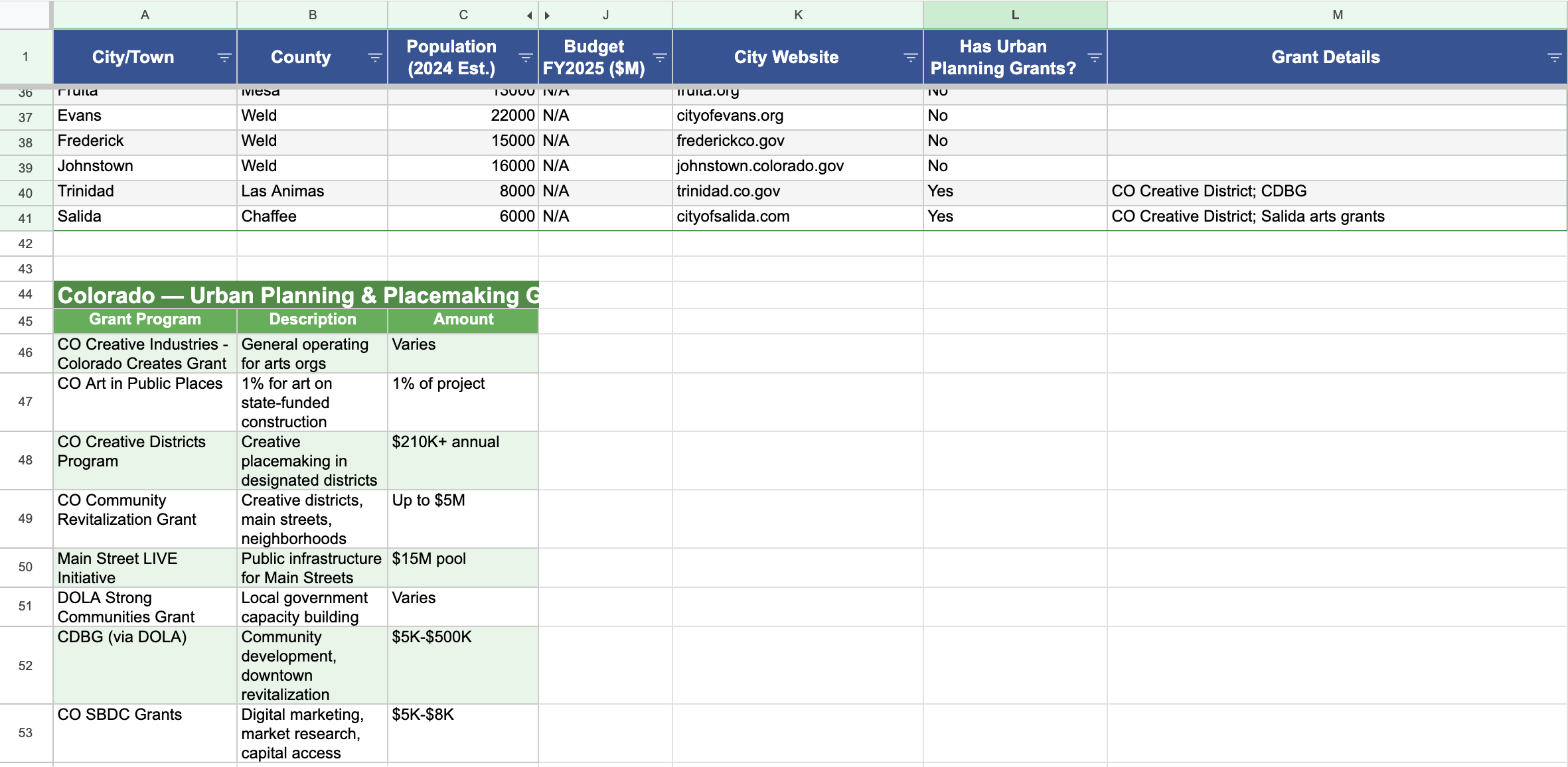
Claude built an Excel workbook with 7 sheets (overview plus one per state). 158 cities total. Each city had five years of budget data, a direct link to the city website, and a grants section showing relevant programs. In aggregate, these municipalities represent billions in combined annual budgets, with the subset that actively funds public space forming Sarah’s serviceable addressable market.
40+ grant programs mapped across all six states. Each tagged with eligibility, amounts, and relevance to Sarah’s specific services.
That’s market intelligence that a business development firm would charge five figures to compile. Sarah got it in a sortable, filterable spreadsheet from one AI session.
The networking playbook and the compiled plan
Grants are one revenue stream. In urban design, relationships drive the other 80%. Claude built a 17-person contact list across two priority tiers, each with a specific reason to connect and a concrete pitch angle. Nine developers to cold-pitch, each with active projects where Sarah’s services were directly applicable. Seven professional organizations to join, with the specific reason each one mattered for her pipeline.
All of this was compiled into a single 15-page document. 14 firms to apply to. 30+ grants with deadlines. 17 networking contacts with outreach strategies. 9 conferences and events. A 90-day action plan broken into specific weekly tasks. Not aspirational. Prioritized and executable.
Weeks 1-2: update resumes, register on procurement portals, join two professional organizations, send five outreach messages. Weeks 3-4: submit first grant application, attend one networking event, pitch three developers. Weeks 5-12: launch freelance service packages, follow up on all applications, build a recurring pipeline.
The numbers
-
Time invested: ~6 hours, one session
-
Cost: $100/month Claude subscription
-
Grants identified: 30+ across 9 categories
-
Total addressable funding: $2M to $4M+
-
Funding received to date: $40,000+
-
Networking contacts: 17, prioritized with outreach scripts
-
Cities researched: 158 across 6 states
-
Documents produced: 1 Excel workbook (7 sheets), 1 Word doc (15 pages)
-
Equivalent consulting cost: $5,000 to $15,000
Why this matters beyond one urban designer
There are roughly 33 million small businesses in the U.S. The vast majority of them have the same problem Sarah had: the founder has real expertise, and no operational infrastructure around it. No analyst on staff. No BD team. No one to do the 40-hour research project that would actually unlock the next stage of growth.
The conventional wisdom is that AI agents are impressive demos that don’t do real work yet. That they hallucinate. That you can’t trust them for anything that matters. And that’s true if you treat them like chatbots, throw them a one-line prompt, and expect magic.
What actually works, and what this use case demonstrates, is the opposite. You give the agent everything. Five resumes. Project descriptions. Website content. Competitive landscape. Your constraints. You spend the first 30 minutes making sure it understands your business the way an analyst joining your team would. And then you let it execute multi-step research and production tasks that would take a human team weeks.
The output isn’t perfect. Claude’s first pass on the networking list included tangential contacts. The redirect: “She’s a solo operator. She doesn’t need 50 names. She needs 17 with a specific reason to reach out this month.” Claude tightened the list immediately. The AI does 85% of the work. Your job is the other 15%: knowing what to ask for, spotting what’s off, and shaping the output.
But 85% of the work at $100/month versus hiring a consultant at $150/hour or a junior analyst at $60K/year? That math isn’t close.
The bottom line
Sarah’s studio is still a one-woman operation. But it’s now a one-woman operation with a grants pipeline, $40K in funding she didn’t have before, a 158-city market database, a networking playbook, and a 90-day execution plan.
We’re still early in this. The tooling will get better. The models will get smarter. The agentic workflows will get more reliable. But even right now, today, a solo business owner with a $100/month subscription and six hours of focused work can build operational infrastructure that would have cost five figures and taken weeks to produce a year ago.
Sam Altman’s betting pool is about billion-dollar one-person companies. I think the more interesting story is the millions of existing small businesses that are about to operate like they have a back office for the first time.
Bhavik Muni is a product analytics professional, recovering startup founder, and apparently now an unpaid small business consultant. He writes about using AI tools for real tasks, not demos. He lives in Utah and is available to talk about agentic AI over chai. Find him on Twitter/X.
If you know a small business owner who could use a strategy team but can’t afford one, send them this.